
Supporting Community-Led Regeneration in Gleadless Valley
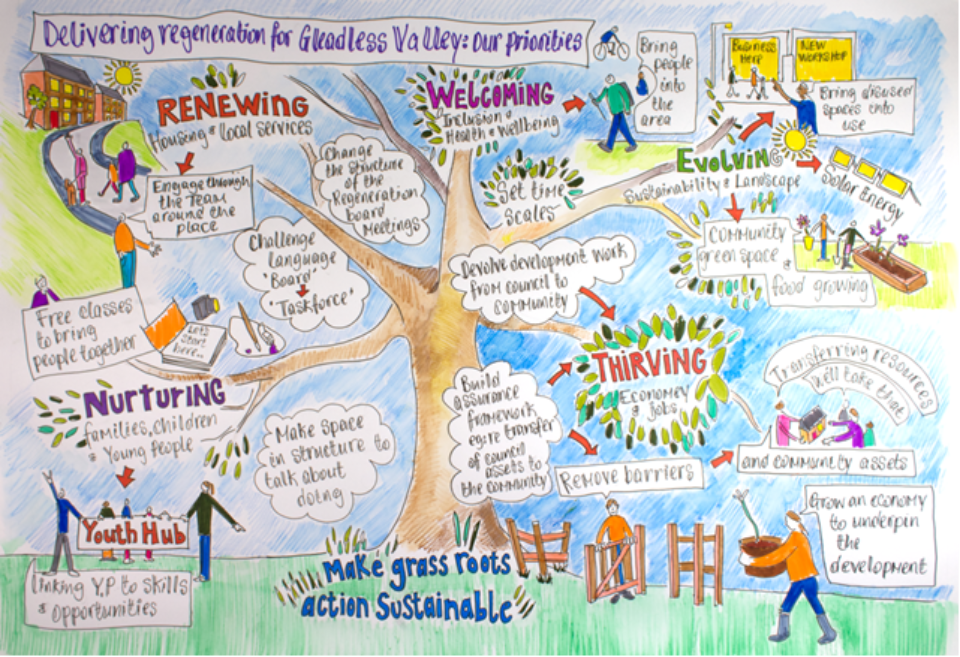
Moving from Engagement to Community-Led Regeneration
Gleadless Valley is a large post-war estate in Sheffield. It was an impressive piece of regeneration, 5,000 homes built in 10 years, inspired by ideas of a brutalist Swiss village which created a real buzz from the outset. However, subsequent lack of investment, long-standing socio-economic challenges and a challenging topography has left the community with segregated sense of identity and low trust in regeneration processes.
As the area entered a critical phase of regeneration, with a refreshed masterplan in development, there was a clear need to ensure that community voice didn’t sit alongside the process — but actively shaped it.
Working in partnership with Heeley Trust and Sheffield City Council, Growing Circles supported a programme designed to move beyond traditional consultation and toward a more community-led approach to regeneration.
This meant combining deep engagement, creative practice and system leadership — ensuring insight translated into action, influence and long-term ownership.
A Different Approach to Engagement
Rather than relying on one-off consultation, the work focused on building a sustained, relational programme of engagement.
This included:
Community conversations, walkabouts and local gatherings
Creative storytelling and community journalism (with fILM fAM)
A photography competition and exhibition capturing everyday life in the Valley
Structured engagement with young people, including a large-scale school’s event
These approaches enabled people to participate in ways that felt natural and accessible — particularly those less likely to engage through formal processes.
Just as importantly, they surfaced rich insight about identity, place and aspiration, helping partners understand how the Valley is experienced day-to-day.
Using Creativity as a Catalyst
One of the most powerful elements of the programme was the community photography project and exhibition.
Residents were invited to answer a simple question:
What does your neighbourhood mean to you?
The response was a collection of images and stories reflecting:
Everyday life and social connections
Landscapes, streets and shared spaces
Memory, belonging and identity
The public exhibition became a pivotal moment — bringing together residents, partners and decision-makers to see the Valley through the lens of lived experience.
It helped to:
Shift the narrative from deficit to possibility
Build trust between communities and institutions
Create space for more open and constructive conversations about the future
Connecting Community Voice to Design and Decision-Making
A key priority was ensuring engagement didn’t sit in isolation, but directly influenced regeneration outcomes.
Community insight fed into:
The Vision for the Valley
The refreshed masterplan and spatial framework
Ongoing conversations with planners, partners and the Regeneration Board
Creative outputs — including photography, film and storytelling — were used not just as engagement tools, but as influencers of decision-making, shaping how stakeholders understood place and prioritised investment.
Investing in the Community
Alongside engagement, the programme focused on ensuring that resources flowed into the community.
This included:
Commissioning local organisations to deliver engagement
Delivering micro-grants and community funding programmes
Supporting local events, ideas and grassroots activity
Community grants enabled residents and groups to take action on priorities such as:
Improving neighbourhood spaces
Supporting young people and families
Strengthening wellbeing and connection
Celebrating local culture
Although modest in scale, these investments were critical in:
Building confidence and momentum
Demonstrating visible change
Supporting emerging local leadership
Strengthening Leadership and System Connection
Alongside community work, we supported Board and leadership development, including a full-day immersion and visioning programme.
This brought together:
Board members
Senior leaders
Community organisations
National regeneration experts
Through site visits, shared insight and facilitated workshops, this created space to:
Reflect honestly on challenges and opportunities
Explore practical models of community-led regeneration
Build confidence in moving beyond consultation toward shared ownership
Impact and Learning
The programme has helped to:
Embed community voice within regeneration design and strategy
Strengthen relationships between residents, partners and the Council
Increase confidence in community-led approaches
Build foundations for long-term governance and local ownership
Create immediate momentum through community-led action
Perhaps most importantly, it demonstrated that relatively modest investment can unlock significant social value when it supports trust, creativity and local leadership.
Why This Matters
This work highlights what it takes to move from engagement to genuine community-led regeneration:
Working relationally, not transactionally
Using creative approaches to surface deeper insight
Connecting community voice directly to design and decision-making
Investing in local capacity, leadership and infrastructure
Supporting systems to shift, not just communities to participate
Looking Ahead
As regeneration in Gleadless Valley continues, the foundations are now in place for a more community-led future.
The challenge — and opportunity — is to build on this momentum:
ensuring that community voice, leadership and ownership remain central to how change happens in the Valley.